

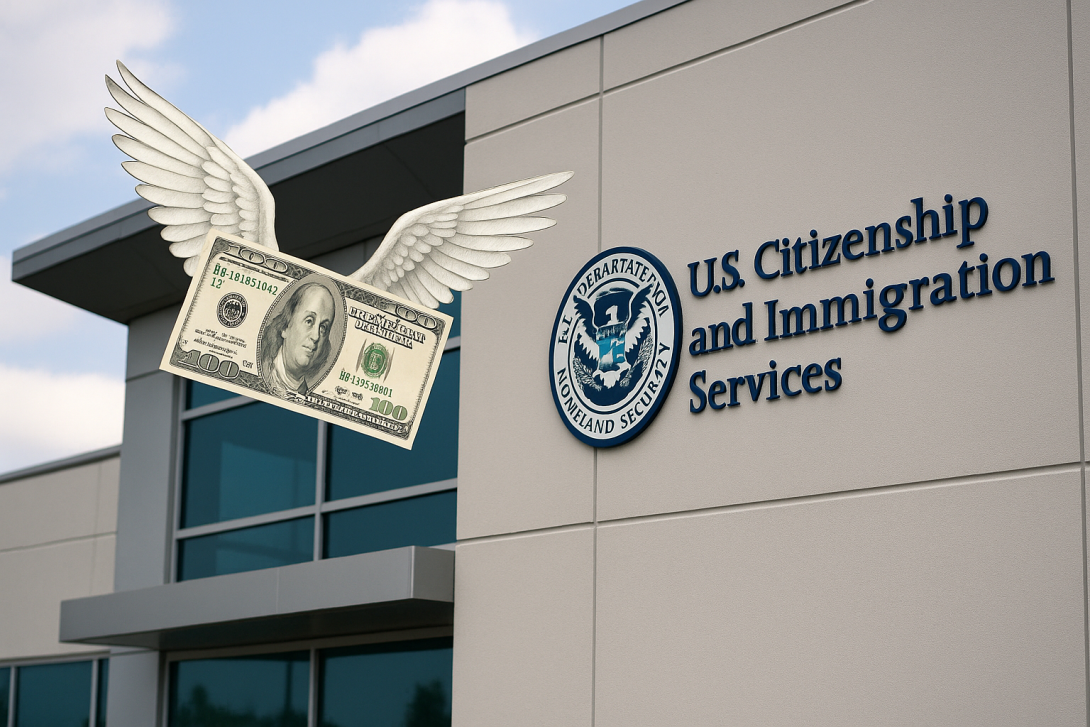
Congress Proposes Big Fee Hikes for Immigration Applications
By C. Matthew Schulz
U.S. employers and foreign nationals who apply for a U.S. visa, work permit, or green card, or to enter the United States may soon face much higher fees.
The U.S. House of Representatives recently introduced the 2025 Budget Reconciliation Bill, proposing sweeping increases to government fees for many immigration services handled by the Department of Homeland Security (DHS) and U.S. Citizenship and Immigration Services (USCIS).
The Bill would impose new and higher costs on people seeking legal immigration pathways, while shifting fee revenue away from the agencies that process these applications.
Fee Increases for Lawful Immigration: What’s Changing?
Here’s what the 2025 Budget Reconciliation Bill proposes for popular immigration applications:
- Form I-129 (Petition for Nonimmigrant Worker). Good news: no direct increase to the I-129 filing fee. Bad news: the bill adds a new $250 “visa integrity fee” on all nonimmigrant visas. This fee would apply when the visa is issued abroad—not when filing I-129 with USCIS. It effectively raises costs for H-1B, L-1, O-1, and similar nonimmigrant visa categories.
- Form I-140 (Immigrant Petition for Alien Worker). There is no increase in the I-140 filing fee under this bill.
- Form I-907 (Request for Premium Processing). There is no increase for the I-907 premium processing fee. Current rates remain as set by DHS under 8 U.S.C. § 1356(u) and previous fee rules.
- Form I-485 (Application for Adjustment of Status). If you file your I-485 with USCIS (not in immigration court), there is no increase. But if your I-485 is filed or adjudicated in immigration court (EOIR), the bill adds an extra $1,500 fee on top of the USCIS fee
- Form I-131 (Advance Parole for I-485 Applicants). There is no increase is proposed for I-131 advance parole filed as part of an I-485 adjustment of status application.
- Form I-765 (Employment Authorization Document for I-485 Applicants). For I-485 applicants applying for an EAD (I-765), there is no increase. Note: the bill raises fees for asylum and parole-based EADs, but not for adjustment-based EADs.
Other Fee Increases: Hefty Costs for Humanitarian Applications and Appeals
Beyond common lawful immigration forms, the bill proposes steep increases elsewhere:
- Asylum application fee: $1,000 (currently $0)
- EAD for asylum applicants: $550 per application, with 6-month validity limits
- TPS application fee: $500 (currently $50 + $30 biometrics)
- Special Immigrant Juvenile fee: $500 (currently $0)
- Appeal to the Board of Immigration Appeals: $900 (up from $110)
- Cancellation of removal (non-LPR): $1,500 (up from $100 + biometrics)
Why Do Immigration Fees Exist? A Brief History of USCIS Fee-Setting
Since 1989, immigration benefit fees have been governed by 8 U.S.C. § 1356(m). This law authorizes DHS to set fees at a level that covers the full cost of providing immigration services. In other words, USCIS is required to ussea fee-funded model, meaning:
- Most of its budget comes from the fees it collects, not taxpayer appropriations; and
- Fees are retained by USCIS to pay for its operations, staff, and technology.
This system allows USCIS to keep running even during a government shutdown because the agency doesn’t depend on annual budget bills passed by Congress.
The fees US employers and foreign nationals pay cover the cost of processing their own case, and those of other applicants.
How the 2025 Bill Would Break This Model
Unlike current law, the 2025 Budget Reconciliation Bill would redirect many fees to the Department of the Treasury rather than USCIS or EOIR.
For example: the asylum fee, appeal fees, and visa integrity fee would mostly go to Treasury, with only a small share earmarked for adjudication agencies.
This shift means: Less funding directly supports the agency processing your case; more money could be diverted to unrelated enforcement or detention operations; and, most importantly, Congress would give up control over how fee revenue is spent, because it wouldn’t flow through annual appropriations for USCIS.
What’s Next? How This Bill Could Become Law
Currently, this bill has passed the House Homeland Security Committee as part of the budget reconciliation process. But it still faces hurdles: a full House vote; a Senate vote (where reconciliation bills can pass by a simple majority, but amendments are possible); and the President’s signature.
Because it’s a reconciliation bill tied to the federal budget, it cannot be filibustered in the Senate (Congressional Budget Act of 1974, § 310), but it must comply with Senate rules (including the Byrd Rule limiting non-budget provisions).
Until the legislative process is complete, these fee increases are not yet law, but stay alert for possible changes and write to your legislator if you do not agree with this proposed action.
Final Thoughts: Plan Ahead, Stay Informed
If you’re considering filing an immigration application in the near future, it’s wise to monitor this bill’s progress. Fee increases could have a big impact on family budgets and business costs. While the bill isn’t law yet, it signals a dramatic shift in U.S. immigration funding.
This article is for informational purposes only and does not constitute legal advice. For advice about your specific case, consult an immigration attorney.